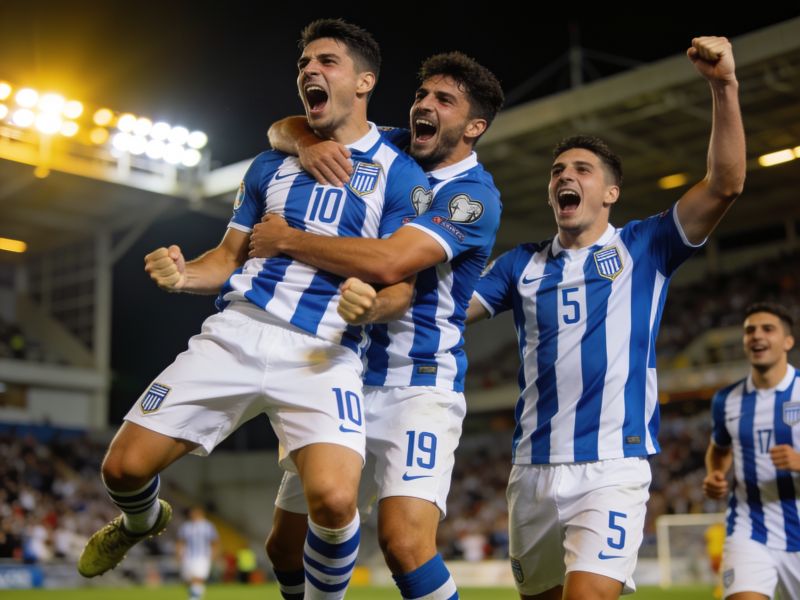
he Greek football team has never been a mere collection of eleven players. It is a living archive of the country's modern emotional history. When Angelos Charisteas headed that ball past Ricardo in Lisbon's Estádio da Luz on July 4, 2004, he did more than score the winning goal of Euro 2004. He detonated a carefully constructed narrative. Portugal, the hosts, the golden generation。the favorites—none of it mattered. What mattered was that a Greek football team, ranked 35th in the world and given odds of 150-1 by bookmakers, had just won a major international tournament. I remember watching that final in a packed taverna in Thessaloniki. When the whistle blew, a man in his seventies next to me wept openly, clutching a worry bead so tightly his knuckles went white. That is the Greek football team for you: it does not just play matches;
it rearranges the furniture of the soul.Otto Rehhagel's tactical blueprint for that triumph was almost aggressively unromantic. A rigid 4-4-2。deep defensive lines, man-marking that bordered on the personal, and a ruthless efficiency from set pieces. The Greek football team averaged just 42% possession across the tournament. They conceded only four goals in six matches. Critics called it anti-football. I call it a masterclass in resource optimization. Rehhagel understood something that the Greek football team's subsequent coaches have often forgotten: this is not a squad built for tiki-taka. It is a squad built for resilience, for the dark arts of defending a one-goal lead, for the kind of collective grit that turns a stadium into a pressure cooker. The 2004 triumph was not a fluke. It was a system—a deeply Greek system of survival through cunning and unity.Fast forward two decades. The Greek football team now operates in a different landscape. The Ethniki, as the national side is known, has qualified for only one major tournament since 2014—the 2024 European Championship, where they exited in the group stage after a valiant draw with Spain and narrow losses to Italy and Croatia. The reasons are structural. The Greek Super League, once a breeding ground for tough, technically limited but tactically disciplined players, has been hollowed out by financial mismanagement and the dominance of Olympiacos and PAOK. Young talent leaves early for Germany, England, or the Netherlands. The Greek football team's midfield, once anchored by the tireless Kostas Katsouranis。now relies on the mercurial but inconsistent Dimitris Pelkas. There is no shortage of heart. There is a shortage of coherent development pathways. I watched a U-21 qualifier in Athens last October. The passing was crisp, the movement intelligent, but the final third decision-making was rushed, almost anxious. That anxiety is learned. It comes from a domestic environment where every misplaced pass is dissected on talk radio for three days.What makes the Greek football team genuinely fascinating, though, is its relationship with its own supporters. The national stadium in Athens—the OPAP Arena—is not a neutral venue. It is a cauldron of noise, flares。and deeply held grievances. When the team plays poorly, the silence is heavier than any booing. When they play well, the roar is physical. I have felt it vibrate through my ribs. This intensity cuts both ways. It fuels comeback victories against the run of play—remember the 2-1 win over England at Wembley in October 2024, a result that stunned the football world and briefly resurrected qualification hopes. It also breeds a fragile confidence. One misplaced backpass and the collective sigh from 60,000 people can be heard in the dressing room. The Greek football team does not simply represent the nation;it absorbs its moods.
Where does that leave the future?The Greek football team needs more than nostalgia for 2004. It needs a coherent identity that fits the modern game. The current coach, Ivan Jovanović, has experimented with a back three and a more possession-oriented approach. Results have been mixed. The talent exists—Christos Tzolis, Konstantinos Koulierakis。
and the veteran Tasos Bakasetas provide a spine. But the gap between potential and performance remains frustratingly wide. I am not pessimistic. Greek football has a habit of producing moments of collective brilliance precisely when logic suggests otherwise. That is its charm. That is its curse. The Greek football team will never be a machine. It will always be a drama—flawed, passionate, and stubbornly alive.